From guesswork to certainty: wireless weighing in sweet pepper and aubergine
Wireless weighing in sweet pepper and aubergine
Anyone working with tomato or cucumber knows how weighing works: a load cell under the substrate slab, a line on the screen, a basis for irrigation. But apply that same approach to sweet pepper or aubergine and something is off. The graphs look plausible — but they don't show what you actually want to measure.
It comes down to how these crops grow.
The problem is in the plant
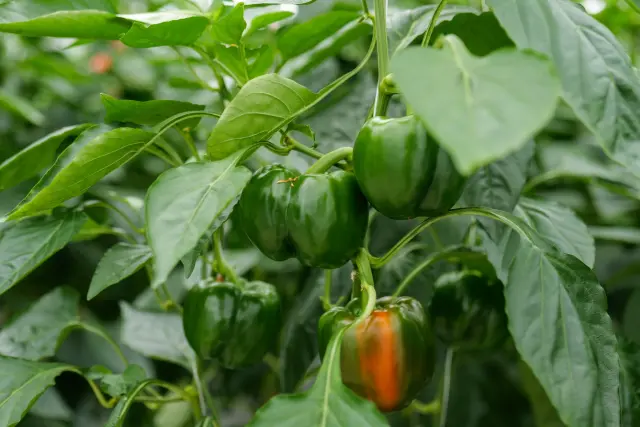
A sweet pepper or aubergine plant ties dozens of stem clusters per square metre to the crop wire. As the season progresses, a growing share of the plant's weight hangs in those wires rather than resting on the substrate. At the same time, the crop wire expands when the greenhouse heats up and contracts when it cools down. That movement is measurable — but it has nothing to do with the plant.
In tomato and cucumber, this effect is negligible. In sweet pepper and aubergine, it creates distortions that make the irrigation line unreadable — across the day and across the season. Traditional weighing doesn't fall short because of the technology, but because the application doesn't fit the behaviour of these crops.
A system that floats free of the greenhouse structure
The Floating-scale was developed to address this problem at its root. The construction is attached to the greenhouse trellis, but designed so that the greenhouse structure itself has no influence on the measurement. The bypass frame — the part that replaces the normal crop wire within the measurement section — ensures that the plant's weight is included in the measurement, while the expansion and contraction of the greenhouse structure stays out of the picture.
The system measures on two layers simultaneously. The total weight (crop, substrate slabs and growing gutter) is suspended from the trellis. The floating gutter (substrate slabs only) hangs two to three centimetres above the standard growing gutter. By measuring both layers at the same time, crop and substrate can be separated — and that separation is the foundation for everything the system can show.
Every greenhouse is different. Whether a grower uses two rows of substrate side by side, or a V-system — where a single row of slabs sits between the paths and plants grow upward in two directions — the setup always requires an on-site assessment. Installation, ideally during the crop changeover, is always preceded by that visit.
Two days after installation: actionable information
Two days after installation is enough for a first conversation about the graphs. Not because nothing is visible before that — on day one you already see what happens when you irrigate, how the slab responds, how the weight rises and falls — but to let the graph settle into the specific situation.
After that, the real reading begins.
Irrigation with absolute figures
The daily dynamics are the most immediate insight. In the evening, the grower stops irrigating. The plant keeps transpiring. The weight drops — to the gram — until irrigation starts again the next morning.
Say the weight drops 150 grams per square metre overnight. That tells you that you need to replenish at least 150 millilitres per square metre. If you also want to produce drain — to make sure every corner of the greenhouse receives enough water — you set 170 or 175 millilitres. And you can verify that on the scale.
This is the core of what the system changes: you move from a percentage or a feeling to a number. 200 grams is 200 millilitres. No more, no less.
Previously, growers steered on light sum (so many joules equals one irrigation cycle), wind direction, time of day. These signals approximate reality. On a cloudy August day with heat but no light, the light sum gives the wrong signal: the sun isn't contributing, but the plant is still transpiring. With the Floating-scale, you simply see it.
From irrigation to growth
Beyond irrigation, the system shows fresh weight gain: how many grams are added per square metre per day? Harvest moments show up as sudden weight drops — and recovery afterwards is visible too. These are figures that in sweet pepper and aubergine cultivation were previously only available in retrospect, after the season. Now they are visible daily, at the moment when they can still make a difference.
Looking further, the system also shows how the plant responds to climate decisions. Did you open the screen too late? Ventilate too early? Those responses show up in the graph. It is the feeling that the plant is answering what you do.
Nine systems, growing sharper
At the start of 2026, nine Floating-scale systems are in use across multiple sweet pepper and aubergine growing operations. Some growers run two or three systems to compare different positions in the greenhouse, or to map differences between varieties.
The growing network has a side effect: each system generates data that is used to test and refine the models. What holds in one greenhouse can be verified in another. What appears at a certain stage of the crop can be recognised as a pattern. With each new system, the models become more precise — and every new user benefits from what has already been learned.
Want to know more?
Curious what the Floating-scale could mean for your operation? Get in touch with our Account Manager Agri, Kees van Vliet — he is happy to look at your situation and what setup would work best.
Get more out of your greenhouse with wireless monitoring. Gain continuous insight into climate and growth, and easily optimize for higher returns.