Low-energy tomato growing is no longer a future concept
What year 3 of the Grodan/Signify trial confirms
Using less heat while harvesting more, and better, tomatoes. It sounds contradictory, but after three years of research by Grodan and Signify, the numbers back it up. Wireless Value was a partner in this trial, alongside Ridder, Normec Groen Agro Control and Axia Vegetable Seeds. Here are the key takeaways for growers.
What was tested
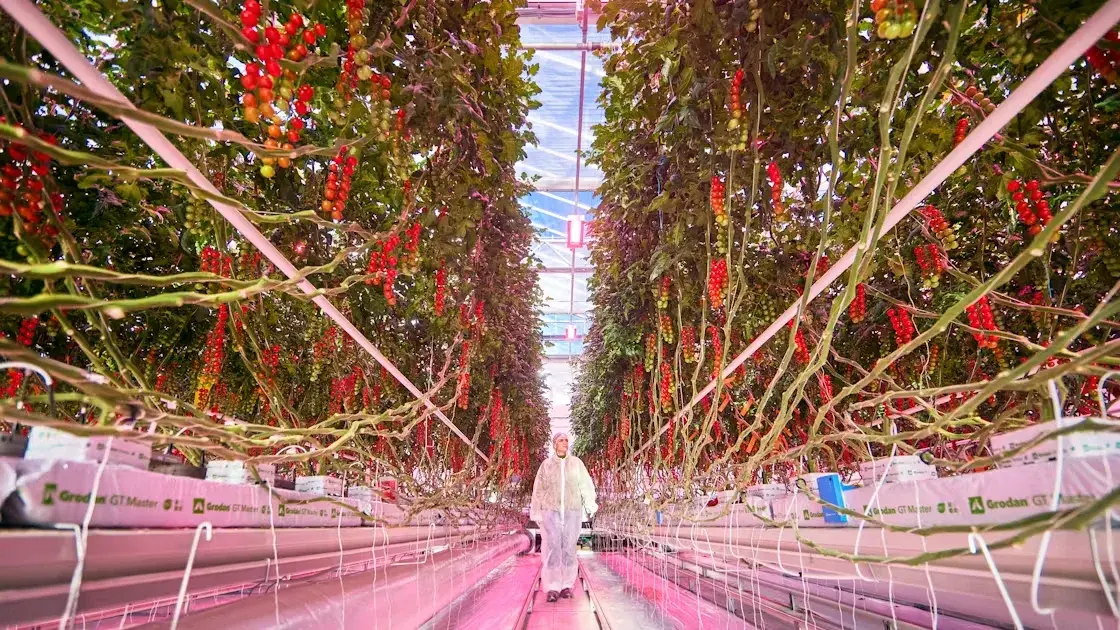
Over three years, researchers at the Botany research centre tested how far a low-energy approach can go under full-LED lighting. Year 1 and 2 focused on the cherry tomato cultivar Vitalion. In the third and final year, the same holistic approach was tested on the larger truss tomato cultivar Macxize, at a higher light level of 350 μmol/m²/s. The technical setup remained largely the same: active air dehumidification combined with advanced insulating screens.
The starting point throughout: don't adjust one variable in isolation, but manage lighting, climate, irrigation and nutrition as one integrated system.
The key results
- More than 50% reduction in heat input through the rail pipe system, thanks to the combination of full-LED lighting, insulating screens and active dehumidification.
- 10% higher yield from combining toplighting with interlighting. The top of the plant becomes light-saturated more slowly, allowing the lower leaves to contribute more to growth.
- 4% higher fruit weight plus an additional cluster, thanks to faster flowering and fruit set.
- Less blotchy ripening (green spots) in the Macxize cultivar by raising the potassium-to-calcium ratio to 3:1 instead of the usual 1:1, combined with weekly uptake analysis.
- Dehumidification stays affordable: the additional electricity cost for active dehumidification remained under 6% of total energy input.
A few terms worth clarifying: LAI (leaf area index) describes the ratio between leaf surface and ground surface, and indicates how much foliage the plant is developing. LUE (light use efficiency) shows how efficiently the plant converts available light into growth. Uptake analysis means having young fruits and mature leaves analysed weekly to see what the plant is actually absorbing, rather than only looking at what's being supplied.
Steering on uptake instead of EC alone
One of the more interesting shifts in this trial: moving away from steering on EC alone, toward steering on the nutrient recipe itself. By lowering the nitrate concentration in the feed (settling on 13 to 15 mmol/l as the lower limit to guarantee sufficient uptake), the team gained better control over LAI, targeting a range between 2.5 and 3.0. Excess leaf volume costs energy: more transpiration means more humidity that needs to be removed.
The team also found that lower isn't always better. At 8 mmol/l in the drip, total nutrient uptake was negatively affected, slowing crop development. In other words, there's a lower limit to generative steering through nitrate, and you only find it by measuring what the plant is actually taking up.
The role of data and sensors
This is exactly where Wireless Value came in as a partner. The trial combined temperature and humidity sensors, plant weight measurement, a net radio sensor from Wireless Value, and Grodan GroSens sensors for root-zone monitoring into a single central platform, integrated via APIs with the Ridder Hortimax Pro climate computer. This allowed the team to make real-time adjustments based on trends in plant weight, EC and water content, rather than relying on isolated measurements.
Our own Kees van Vliet also shares his perspective on a persistent misconception in Grodan's "Breaking the Myth" video series: the idea that water uptake automatically means weight gain in the plant. You'll find that video on YouTube.
A critical note
Before applying all of this directly to your own operation: these results were achieved in a research facility, with one cultivar, one lighting strategy, and equipment (active dehumidification, double screens) that not every grower has as standard. Andrew Lee of Grodan himself notes that the approach is transferable "to some extent" — the underlying way of thinking, using data to make targeted steering decisions, applies more broadly than the exact figures do. If you raise your light level or add interlighting, your climate, CO2 and irrigation strategy need to move with it. Adjusting one dial in isolation won't get you the same result.
Want the full results?
The complete whitepaper from Signify and Grodan includes all graphs, the full trial setup and the exact nutrient schedules used.
For more background, videos and the earlier trial years, visit Grodan's knowledge page: Low energy tomato growing – Grodan
Wireless Value was a data partner in this three-year trial by Grodan and Signify, alongside Ridder, Normec Groen Agro Control and Axia Vegetable Seeds.
Get more out of your greenhouse with wireless monitoring. Gain continuous insight into climate and growth, and easily optimize for higher returns.